


As an Amazon Associate, Party Baby Seattle earns from qualifying purchases. Product ideas and setup recommendations are shared for informational and inspirational purposes only.
Balance bikes for 2 to 4 year olds give little riders a way to practice steering, pushing, and balancing before moving on to a traditional pedal bike. But not every balance bike works the same way. Some focus on simple two-wheel riding, while others add folding frames, convertible riding modes, wooden construction, or electric power.
We’ve styled over 800 events, and active play works best when the activity matches both the child and the space available. These seven picks cover first-time riders, everyday adventures, travel, lightweight riding, and families looking for a bike that can change as their child grows.
What’s in this Guide
- Our Top Picks in Balance Bikes for 2 to 4 Year Olds
- What Matters in Balance Bikes for 2 to 4 Year Olds
- Best Overall: Radio Flyer Air Ride
- Best for Everyday Riding: KRIDDO Upgraded Balance Bike
- Best for Travel: YGJT 3-in-1 Folding Balance Bike
- Best Lightweight: Strider 12 Sport
- Best Wooden: Kinderfeets Tiny Tot Plus
- Best Electric: GROWNEER Electric Balance Bike
- Best Splurge: JMMD 6-in-1 Toddler Bike
- Setting Up Balance Bikes for 2 to 4 Year Olds
- Frequently Asked Questions
Our Top Picks in Balance Bikes for 2 to 4 Year Olds
- Best Overall: Radio Flyer Air Ride
- Best for Everyday Riding: KRIDDO Upgraded Balance Bike
- Best for Travel: YGJT 3-in-1 Folding Balance Bike
- Best Lightweight: Strider 12 Sport
- Best Wooden: Kinderfeets Tiny Tot Plus
- Best Electric: GROWNEER Electric Balance Bike
- Best Splurge: JMMD 6-in-1 Toddler Bike
- Shop All Balance Bikes for 2 to 4 Year Olds on Amazon
What Matters in Balance Bikes for 2 to 4 Year Olds
Start with seat height and rider fit. A child should be able to sit comfortably with both feet reaching the ground, making it easier to push forward, stop, and steady the bike without help. Adjustable seats are especially useful during these years because children can outgrow a fixed riding position quickly.
Weight and tire design matter too. A lighter bike is easier for a small rider to maneuver and easier for a parent to carry when the ride is over. Air-filled tires add cushioning on outdoor surfaces, while puncture-proof tires remove the need to maintain air pressure.
Consider the riding style as well. A traditional two-wheel balance bike focuses on balance and steering. Convertible models offer additional configurations for children moving between supported riding and independent balancing. Electric models introduce powered movement and require closer adult supervision.
Best Overall: Radio Flyer Air Ride
The Radio Flyer Air Ride is a straightforward choice for kids learning the basics of balancing, steering, and coasting. Its air-filled tires give it a more traditional bike feel for outdoor riding, while the lightweight frame keeps it manageable for younger riders. Assembly takes just a few minutes, and the seat adjusts without tools as a child grows.
- Recommended for ages 18 months to 5 years
- Measures 34.05 by 16.05 by 22.5 inches
- Supports up to 49 pounds and weighs 7.94 pounds with 12-inch air tires

💡 Pro Tip. Retighten the Air Ride’s fasteners after the first few outings. Parents like the sturdy feel overall, but some mention parts loosening with repeated riding, so an early adjustment can help keep everything secure.
Best for Everyday Riding: KRIDDO Upgraded Balance Bike
The upgraded KRIDDO is built for regular rides with practical details that become useful once a bike starts going beyond the playroom. Front and rear fenders add coverage for outdoor riding, while the front light gives kids extra illumination in dimmer spaces. Upgraded bearings and stable tires round out a design focused on everyday riding.
- Recommended for ages 2 to 5
- Measures 33 inches long and 20.3 inches high
- Supports up to 110 pounds with a seat height from 13.2 to 16.7 inches

💡 Pro Tip. Set the seat so your child can plant both feet comfortably before heading out for a longer ride. Parents report mixed experiences with sizing and handling, so a few slow practice runs at home can make the right seat position easier to find.
Best for Travel: YGJT 3-in-1 Folding Balance Bike
The YGJT makes sense for families who want one bike that is easier to store between rides and can change as riding skills develop. One-click controls simplify the switch between configurations, and the frame folds when it is time to put the bike away. Assembly takes just a few minutes with the included tools.
- Recommended for ages 2 to 5
- Measures 28.3 by 20.5 by 21.6 inches
- Supports up to 55 pounds and weighs 10.41 pounds with a seat height from 15.7 to 18.5 inches

💡 Pro Tip. Start with a few slow rides in tricycle mode so your child can get used to where their feet sit around the rear wheels. Parents mention feet getting caught near the wheels, making slower practice especially useful before longer rides.
Best Lightweight: Strider 12 Sport
The Strider 12 Sport gives toddlers a lightweight introduction to riding without pedals getting in the way. Its adjustable seat and handlebars allow the bike to grow with a child, while built-in footrests give developing riders a place to rest their feet once they start coasting. The never-flat EVA tires can handle different riding surfaces without ongoing tire maintenance, and the bike comes mostly assembled for a quick setup.
- Recommended for ages 18 months to 4 years
- Measures 27.56 by 7.09 by 12.2 inches
- Supports up to 60 pounds and weighs 6.7 pounds with 12-inch never-flat EVA tires

💡 Pro Tip. Start with short rides on a flat surface and let your child practice pushing and coasting at their own pace. Parents frequently mention how quickly kids figure out the Strider 12 Sport, and its lightweight frame makes those first steering and balancing attempts easier to manage.
Best Wooden: Kinderfeets Tiny Tot Plus
The Kinderfeets Tiny Tot Plus gives families a wooden alternative to the mostly metal and plastic designs in this roundup. It starts with added support for early riders and can later change to two wheels, giving kids a gradual path toward independent balancing. Puncture-proof tires also remove the need to maintain air pressure.
- Recommended for ages 18 months to 4 years
- Measures 28.3 by 17.7 by 17.3 inches
- Supports up to 55 pounds and weighs 4.4 pounds with a seat height from 10 to 13 inches

💡 Pro Tip. Let your child get comfortable with the three-wheel setup before converting the Kinderfeets to two wheels. Parents especially like having both configurations, and some describe the transition as a helpful bridge into independent balancing.
Best Electric: GROWNEER Electric Balance Bike
The GROWNEER is the outlier in this roundup for kids ready to move beyond a completely foot-powered ride. Electric power changes the riding experience considerably, while the illuminated front wheel adds a playful detail that stands apart from the conventional bikes here. An adjustable seat helps accommodate the rider as they grow. Powered riding calls for close adult supervision, appropriate protective gear, and a controlled riding area.
- Recommended for ages 3 to 6
- Measures 35.43 by 20.47 by 21.65 inches
- Supports up to 55 pounds and weighs 15.72 pounds with 12-inch pneumatic tires
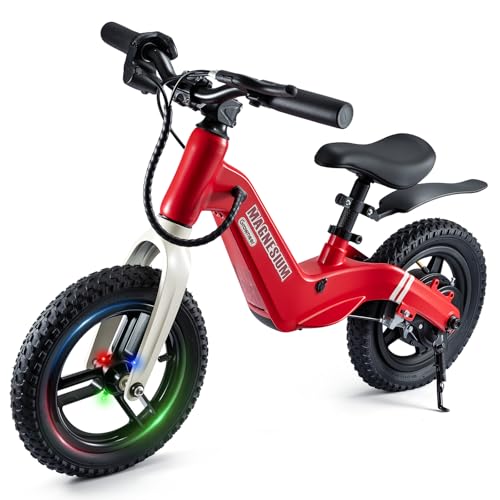
💡 Pro Tip. Keep the first few powered rides short and close to home before planning a longer outing. Parents report mixed reliability during early rides, so shorter sessions make the first outings easier to manage.
Best Splurge: JMMD 6-in-1 Toddler Bike
The JMMD is designed for families who want one purchase to cover several stages of learning to ride. Instead of committing to a single configuration, parents can change the setup as a child becomes ready for more independence. It arrives 95 percent preassembled, with the remaining assembly taking about five minutes.
- Recommended for ages 18 months to 5 years
- Measures 34.25 by 14.57 by 21.26 to 23.23 inches
- Supports up to 55 pounds with a seat height from 13.39 to 18.5 inches

💡 Pro Tip. Use the parent push rod during the riding stages designed for it, especially while your child is learning a new configuration. Parents appreciate how easily the JMMD changes between riding modes, and the push rod provides additional support when used in the appropriate setup.
Setting Up Balance Bikes for 2 to 4 Year Olds
Have kids wear a properly fitted helmet and use a riding area away from traffic, stairs, and other hazards. Give balance bikes a clear riding area with enough room for kids to push off, coast, turn, and stop without running directly into furniture or another play zone. A firm, level surface also makes it easier for new riders to focus on balancing and steering before moving onto grass or more uneven outdoor terrain.
For younger toddlers who are just getting started, our best balance bikes guide covers beginner-friendly options for ages 18 months and up.. Our ride-on toys guide has more riding ideas, while our rocking horses guide offers an indoor option for kids who love movement.
Shopping for the holidays? Our big Christmas gifts for toddlers guide has more gift ideas for active toddlers and preschoolers, including larger toys that encourage movement and imaginative play.
Planning a Seattle-area celebration with more room for active play? Party Baby Seattle’s soft play packages create a dedicated space for younger kids to climb, crawl, and play together.
Frequently Asked Questions
Age 2 is a common starting point for a traditional two-wheel balance bike. Most picks in this guide start between 18 months and 2 years, and several run through age 5.
Yes. Balance bikes help 2-year-olds practice pushing, steering, coasting, and balancing without having to coordinate pedals. A properly sized bike gives younger riders control over their movement while building confidence.
Yes. Several balance bikes in this guide are recommended through age 4 or 5, and the electric pick extends through age 6.
A balance bike is better for practicing two-wheel balance, while a tricycle provides three-wheel stability. Convertible models offer both riding stages in one design, allowing children to begin with added support before moving to two wheels.
Yes. Kids should wear a properly fitted helmet whenever they ride a balance bike.
Yes. Balance bikes can be ridden on grass, although firm, level pavement is easier for beginners learning to push, coast, and steer.
Disclaimer: All product recommendations, setup suggestions, and creative tips are provided for informational and inspirational purposes only. Party Baby Seattle is an independent publisher. We are not officially affiliated with, sponsored by, or endorsed by the specific brands or manufacturers featured in this article. Party Baby Seattle is not responsible or liable for the safety, durability, or real-world performance of any third-party products or gear mentioned. Always refer to individual manufacturer instructions, safety warnings, and official age guidelines before use.