


As an Amazon Associate, Party Baby Seattle earns from qualifying purchases. Product ideas and setup recommendations are shared for informational and inspirational purposes only.
A backyard trampoline is the biggest play purchase most families ever make, and the marketing makes every one of them sound equally safe. They are not. We write gear guides the boring way, certifications, standards, and construction specs rather than sponsorships, and for this guide that meant reading the ASTM consumer trampoline standard and the pediatric injury data. What that homework turns up is useful. Almost every meaningful safety difference between trampolines comes down to two things you can check on any listing in under a minute, and neither of them is the feature the box advertises loudest.
This guide sorts the field by those two specs, from the premium engineering tier down to the value picks, with a dedicated tier for toddlers, because the littlest jumpers need a different machine, not a smaller version of the big one.
What’s in this Guide
The Two Specs That Decide
First, where the net attaches. The pediatric injury data shows that roughly a quarter to a third of trampoline injuries happen when a jumper falls off, and about another fifth come from contact with the springs or frame. A net anchored at the inside edge of the jumping mat closes off both paths at once, because a falling jumper never reaches the spring bed. A net attached outside the springs leaves a gap that feet and legs can drop into. Same word on the box, very different machine.
Second, what sits under the mat. Traditional trampolines use steel coil springs, and the better ones bury them under generous padding or move the net inside them. Springless designs replace the coils entirely with flexible composite rods beneath the jumping surface, which removes the spring contact category outright. That engineering is what you are paying for at the premium tier.
The baseline underneath both specs is certification. Consumer trampolines sold in the US certify to ASTM F381, with enclosures covered by ASTM F2225, and Amazon requires that testing for anything listed. Treat the certification as the floor, not the finish line, and spend your comparison time on the two specs above it.
Our Top Picks
- Best Overall: Springfree Medium Round →
- Best Spring-Based: Skywalker Jump N’ Dunk →
- Best for Toddlers: Little Tikes 3’ Trampoline →
- Best Budget Route: Shop the category →
Best Overall: Springfree Medium Round
Why it made the list: The company that solved the spring problem by deleting it. Springfree invented the springless design, flexible composite rods sit beneath the mat instead of steel coils at its edge, the frame hides below where no jumper can reach it, and the net mounts on flexible rods at the mat’s own edge. Every one of those choices maps directly onto the injury categories in the pediatric data, which is not something most trampoline marketing can claim.
Springless Square Backyard Trampoline with Enclosure for Kids - 11ft or 13ft Sizes & Optional Add-On Attachments & Accessories

The premium engineering pick and the most awarded trampoline brand on the market, backed by a 10-year warranty on every part, not just the frame. The SoftEdge mat absorbs impact at the perimeter where traditional padding thins out, and the whole machine is built to be the last trampoline the household buys. It costs the most on this list by a comfortable margin, and the honest math is the same as the premium balance bike, high price in, a decade of service and strong resale out.
💡 Pro Tip: Springfree assembly is famously slow, most owners report an afternoon or two. Budget the time once and it never comes up again, or use the brand’s installation option and skip the afternoon entirely.
Best Spring-Based: Skywalker Jump N’ Dunk
Why it made the list: The spring-based pick that gets the single spec this guide is built on exactly right, because Skywalker’s patented enclosure attaches at the inside edge of the springs. Plenty of trampolines at this price still hang the net outside the spring bed. This one does not, and that difference costs nothing extra.
Transform your backyard into the ultimate basketball court with the Skywalker Trampoline for Kids and Adults Jump ‘N’ Dunk Trampoline with Net Enclosure. This recreational trampoline is perfect for getting children and adults outside and active, with a basketball hoop to practice shots.

The proven value pick, sold in 8, 12, and 15 foot sizes with a galvanized steel frame, heavy-gauge springs, and the no-gap enclosure design the brand built its name on. The included basketball hoop is the feature kids remember, soft and breakaway by design. Assembly takes patience and the hoop is a bonus rather than a gym fixture, that is the trade at this tier, but the safety architecture where it counts matches trampolines at several times the price.
💡 Pro Tip: Pick the size by your yard, not your ambition. Every size needs clear space around the full perimeter and open sky above, and the 8 foot version with proper clearance beats the 15 foot version wedged against a fence.
Best for Toddlers: Little Tikes 3’ Trampoline
Why it made the list: Full-size trampolines certify to a standard written for ages six and up, which is exactly why the toddler category exists as its own machine. Inches off the ground, one small jumper, indoor footprint, and the fall height of a couch cushion. For the one-to-five crowd this is not the compromise pick, it is the age-matched one.
This Little Tikes 3-foot kid's trampoline is the perfect size to provide hours of bouncing fun! Little Tikes knows it is important for kids to stay active, and this toddler trampoline is easy to move so kids can bounce where ever they like any time they like!
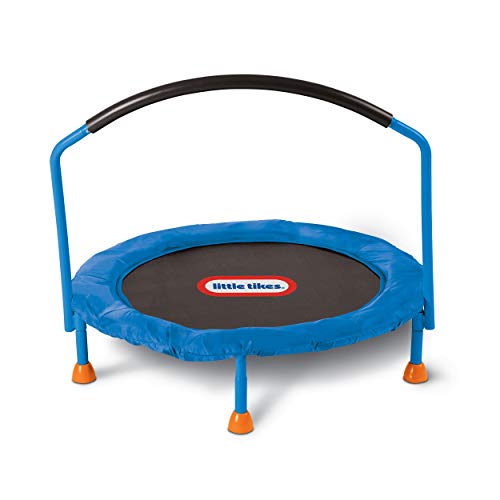
The classic first trampoline from the brand that owns toddler play, sized for one small jumper and low enough that stepping off is a step, not a fall. It lives indoors, which means it earns its keep in a Seattle winter the way no backyard trampoline can, burning the exact energy that otherwise goes into the couch.
💡 Pro Tip: The house rule that makes a toddler trampoline work is the same as the big one, one jumper at a time. Siblings take turns, and the waiting sibling gets the job of counting jumps, which at this age is somehow half the fun.
Best Budget Route: Shop the Category
Why it made the list: Below the named tiers the field rotates constantly, and the same two specs sort it. Before any budget listing earns a click of your money, check that the net attaches at the inside edge of the springs, that ASTM F381 appears in the listing text, that the single-jumper weight rating is stated rather than just the headline total capacity, and that an anchor kit is included or cheap to add.
💡 Pro Tip: Total weight capacity is a marketing number, most injuries happen with multiple jumpers on the mat, and the honest spec is the single-jumper rating. A listing that states both is a listing you can trust a little more.
Setting It Up the Safe Way
The machine is half the safety story. The setup is the other half, and it costs almost nothing.
- Level ground, and the lower the better. Ground-level installation shrinks the fall height to zero, and if digging is not an option, flat and level is the requirement.
- Clear space around the full perimeter and open sky above. No fences, branches, or furniture inside the landing zone.
- Anchor it. A wind kit is the difference between a trampoline and a kite in a Pacific Northwest storm, and it installs in minutes.
- One jumper at a time. Most injuries in the pediatric data happen with multiple jumpers on the mat, and the smallest jumper takes the worst of it. This rule outperforms every accessory sold.
- No somersaults or flips. The severe injuries in the data cluster around attempted flips.
- Remove the ladder when jump time ends, so the youngest household members cannot climb up unsupervised.
- Inspect pads, net, and stitching each spring, and retire parts the season they wear rather than the season they fail.
- Call your home insurer before assembly, not after. Some policies exclude trampolines and the phone call is free.
FAQ
Follow the age guidance on the model you buy. Full-size backyard trampolines certify to a standard written for ages six and up, and the toddler models above exist precisely so younger kids get a machine sized and sprung for their weight. Matching the machine to the kid is the whole game.
They remove one whole category of injury, the spring and frame contact that accounts for roughly a fifth of trampoline injuries in the pediatric data. They do not change the physics of falls or collisions, which is why the one-jumper rule matters just as much on a springless model.
They address the falls-off category, which is the largest one, but the standards bodies are direct that an enclosure alone will not prevent all injuries. Where the net attaches matters more than whether one is included, and no net substitutes for one jumper at a time.
The size your yard can hold with full clearance around and above it. A bigger mat does not mean more jumpers, the one-at-a-time rule holds at every size, so buy for the space rather than the guest list.
Ground level removes fall height, which is a real safety gain, and it looks better in the yard. The trade is excavation cost and drainage work. If the budget allows it, it is the best version of any trampoline you choose. If not, an anchored, level above-ground setup with the right net design covers most of the distance.
They are the single most requested big gift in the backyard category, and the practical move is the family gift, one big item instead of twenty small ones. Our second birthday gift ideas guide covers the rest of the big-motion tier, and the outdoor party must-haves guide covers what to set up around it.
Party Baby Seattle is an independent publisher. Recommendations are our own, and we are not sponsored by any brand listed. All product recommendations are provided for informational and inspirational purposes only. Always refer to individual manufacturer instructions, safety warnings, and official age guidelines before use.