


As an Amazon Associate, Party Baby Seattle earns from qualifying purchases. Product ideas and setup recommendations are shared for informational and inspirational purposes only.
Push walkers for toddlers can be especially useful during the stretch between pulling up and walking independently. The right design gives little hands somewhere to hold while leaving room to practice balance, movement, and direction.
Some walkers focus on controlled movement. Others add activity panels, wagon storage, or adjustable features that keep the toy interesting beyond those first supported steps. We’ve styled over 700 events, and milestone gifts like these make the most sense when they fit what a child can actually do right now.
These seven picks cover different stages and styles of play, from an activity walker for everyday play to wooden designs and a wagon that can keep rolling well into toddlerhood.
What’s in this Guide
- Our Top Picks in Push Walkers for Toddlers
- What Matters in Push Walkers for Toddlers
- Best for Everyday Play: VTech Sit-to-Stand Learning Walker
- Best Montessori-Style Walker: WOODMAM Push Baby Walker
- Best Splurge: Skip Hop 5-in-1 Baby Walker
- Best for New Walkers: Fisher-Price Steady Speed Panda Walker
- Best Walker Wagon: Radio Flyer Push & Pull Walker Wagon
- Best No-Batteries Pick: Melissa & Doug Chomp & Clack Alligator
- Best Weighted Base: CUTE STONE 2-in-1 Baby Walker
- Setting Up a Push Walker at a First Birthday
- Frequently Asked Questions
Our Top Picks in Push Walkers for Toddlers
- Best for Everyday Play: VTech Sit-to-Stand Learning Walker
- Best Montessori-Style Walker: WOODMAM Push Baby Walker
- Best Splurge: Skip Hop 5-in-1 Baby Walker
- Best for New Walkers: Fisher-Price Steady Speed Panda Walker
- Best Walker Wagon: Radio Flyer Push & Pull Walker Wagon
- Best No-Batteries Pick: Melissa & Doug Chomp & Clack Alligator
- Best Weighted Base: CUTE STONE 2-in-1 Baby Walker
- Shop All Push walkers for toddlers
What Matters in Push Walkers for Toddlers
Start with stability and wheel movement rather than the number of activities attached to the front. A beginning walker needs enough resistance to practice moving forward without the walker getting too far ahead. Adjustable resistance can become more useful as confidence and walking speed change.
Footprint matters too. A wider base requires more room around furniture and narrow passages. Handle height should suit the child’s current stage without encouraging an awkward reach. Activity panels, storage, wagon bodies, and convertible play modes can add longevity, but the walking function should still suit the child first.
Best for Everyday Play: VTech Sit-to-Stand Learning Walker
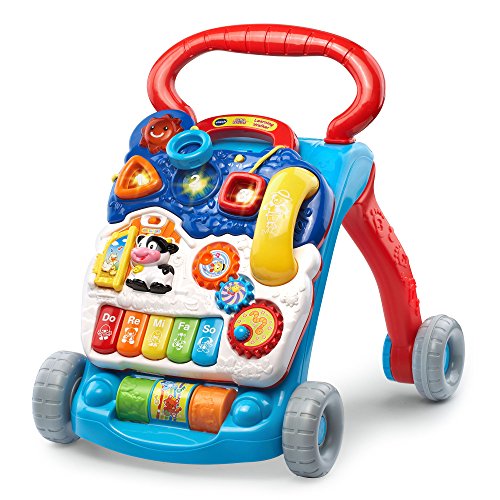
The VTech Sit-to-Stand Learning Walker combines walking practice with a removable activity panel that can be enjoyed away from the frame. It is recommended for ages 9 to 36 months. That mix of floor play and push-along play makes it a versatile choice for everyday use as mobility develops.
- 16.5 by 14.2 by 18.1 inches
- Removable activity panel provides another play configuration
- No-tool assembly keeps initial setup straightforward
💡 Pro Tip. If the walker will move between hardwood and carpet, try it on both surfaces before longer walking sessions so you know how freely it rolls on each. If repetitive toy sounds are a concern, factor that into where it will get the most play since the audio is the recurring complaint in owner feedback.
Best Montessori-Style Walker: WOODMAM Push Baby Walker
The WOODMAM stands apart for its wooden Montessori-style design paired with adjustable rolling resistance. It is intended for ages 12 months and up. The combination gives families a wooden option that still allows the rolling speed to change as walking skills develop.
- 12.9 by 6.6 by 16.9 inches
- Adjustable rolling resistance changes how freely the wheels move
- Detachable activities add play away from walking practice

💡 Pro Tip. Set the rolling resistance to match the child’s current pace, then check that the wheels remain securely attached before walking practice. Owners liked being able to control the rolling speed, but reports of wheels coming off make the wheel connections worth checking regularly.
Best Splurge: Skip Hop 5-in-1 Baby Walker
The Skip Hop 5-in-1 offers the broadest range of configurations in this lineup. It is intended for ages 6 months and up. Its convertible format gives it a longer play progression than a basic push walker.
- 18.5 by 16.3 by 18 inches
- Three handle-height settings accommodate growth
- Adjustable speed control changes how quickly the walker moves

💡 Pro Tip. Adjust the handle height for a comfortable standing position first, then choose the speed setting based on how the walker moves on your flooring. Owners report successful use on both carpet and hard floors, so the adjustable settings are most useful when matched to the child and surface.
Best for New Walkers: Fisher-Price Steady Speed Panda Walker
The Fisher-Price Panda is geared toward the early mobility stage. It is recommended for ages 6 months to 3 years. Its sturdy frame and slower-paced Steady Speed wheels are designed to support beginning walkers as they pull up, balance, and start practicing steps.
- 19.75 by 16 by 17 inches
- Thick handle gives small hands a substantial gripping area
- Front play area includes activities and three shape blocks

💡 Pro Tip. Give a new walker a clear, straight stretch of floor for the first practice sessions and watch how quickly the Panda moves before adding turns. Owners praise its stability for pulling up, but some report that the rolling pace is faster than expected.
Best Walker Wagon: Radio Flyer Push & Pull Walker Wagon
The Radio Flyer converts from walking support into a pull-along wagon. It is recommended for ages 1 to 4 years. The wagon body also gives toddlers a place for toys, turning the product into something they can continue incorporating into play after their steps become steadier.
- 18.3 by 13.9 by 17.7 inches
- 35-pound weight capacity
- Deep wagon body provides storage for toys and pretend play
Ages 1-4 Years, Red | Locking Handle for Stability, Baby Push Walker Converts to Pull Wagon, Indoor & Outdoor Play

💡 Pro Tip. Before walking practice, make sure the wheels are secure and the handle is firmly in the intended position. Owner feedback includes wheels coming off and a handle swinging farther than expected, making those two hardware points worth checking before use.
Best No-Batteries Pick: Melissa & Doug Chomp & Clack Alligator
The Melissa & Doug Chomp & Clack takes a simpler approach to activity play. It is designed for ages 12 months to 2 years. Instead of an electronic panel, forward movement activates three wooden alligators, giving toddlers an immediate cause-and-effect response as they push.
- 15 by 15 by 11.75 inches
- Three wooden alligators move as the walker rolls
- Spinning details provide additional hands-on play

💡 Pro Tip. If noise matters in your play space, know that the chomping action is intentionally noticeable as the walker rolls. Check the painted wooden surfaces periodically too, since owner feedback includes reports of chipped wood and peeling paint.
Best Weighted Base: CUTE STONE 2-in-1 Baby Walker
The CUTE STONE stands out for giving parents more control over how quickly the walker rolls as walking skills develop. It is recommended for ages 12 months and up. Adjustable wheel resistance changes the rolling speed, while a fillable rear tank can add weight to the walker mode.
- Handle adjusts from 16.93 to 17.72 inches
- Two wheel-speed settings change rolling resistance
- Detached activity table measures about 8 to 9.5 inches high and 9.5 inches wide

💡 Pro Tip. Start with the slower wheel setting during early walking practice, then increase the speed as balance improves. Owners specifically liked being able to change the rolling resistance as walking skills developed. The detached activity-table mode drew a tipping complaint when a child leaned heavily on one side, so that configuration is better suited to activity play than leaning support.
Setting Up a Push Walker at a First Birthday
A push walker works best with enough open floor space for a toddler to move forward without immediately having to steer around furniture. Long, clear stretches also make it easier to see how quickly a walker moves on the flooring in that room.
At a first birthday, a walker can sit alongside gifts chosen for the same developmental stage. Our first birthday gift ideas guide can give parents more ideas for building a gift list around what a one-year-old is starting to do.
The walker’s footprint matters after the party too. A compact activity design fits into a play area differently than a wagon or wider wooden walker. Our best ball pits for toddlers guide offers another way to think about active-play pieces when planning a toddler play space.
Party Baby Seattle also offers soft play packages for first birthdays that need a larger designated toddler play area with room for little ones to move and explore.
Frequently Asked Questions
Yes. Push walkers give toddlers something to hold while practicing supported steps. A sturdy base and appropriate wheel resistance are useful features during the learning-to-walk stage.
Babies can start using a push walker from about 6 months if the specific walker is designed for that age and they are ready for its supported activities. The picks in this roundup have recommended starting ages between 6 and 12 months.
No. Adjustable wheel resistance is not required, but it can be useful for new walkers. More resistance can slow movement during early steps, while a faster setting can suit a child with stronger balance and walking control.
No. Wooden and plastic walkers offer different types of play. Wooden designs often emphasize mechanical or hands-on activities, while plastic designs commonly include electronic activities, removable panels, or convertible configurations.
Yes. Push walkers can work on carpet when their wheels move effectively across that surface. Customer feedback for the VTech and Skip Hop models specifically mentions successful movement across both carpet and hard flooring.
Yes. A push walker can be a practical first birthday gift when the product’s recommended age includes 12 months. Activity panels, wagon storage, adjustable features, and convertible configurations can also keep the gift useful as walking skills develop.
Disclaimer: All product recommendations, setup suggestions, and creative tips are provided for informational and inspirational purposes only. Party Baby Seattle is an independent publisher. We are not officially affiliated with, sponsored by, or endorsed by the specific brands or manufacturers featured in this article. Party Baby Seattle is not responsible or liable for the safety, durability, or real-world performance of any third-party products or gear mentioned. Always refer to individual manufacturer instructions, safety warnings, and official age guidelines before use.


