


As an Amazon Associate, Party Baby Seattle earns from qualifying purchases. Product ideas and setup recommendations are shared for informational and inspirational purposes only.
Toddler learning towers bring little kids closer to counter height for everyday activities such as baking, food prep, washing hands, and hands-on projects. The category includes everything from traditional wooden towers to folding designs, convertible furniture, and models with built-in activities.
After styling more than 800 events, we know that the right kids gear has to make sense for the space around it. For this guide, the focus is on learning towers with noticeably different designs, storage options, and features rather than filling the list with nearly identical wooden models.
What’s in this Guide
- Our Top Picks for Toddler Learning Towers
- What Matters in a Toddler Learning Tower
- Best Overall: Ocodile Toddler Tower with Sliding Door
- Best Convertible: OMEW Toddler Standing Tower
- Best for Small Spaces: Little Partners Explore ‘N Store
- Best Metal Frame: HBTower Kids 2 Steps Step Stool
- Best Activity Tower: FlyingBoom Foldable Toddler Tower
- Best Splurge: Guidecraft Contemporary Kitchen Helper
- Setting Up a Toddler Learning Tower
- Frequently Asked Questions
Our Top Picks for Toddler Learning Towers
- Best Overall: Ocodile Toddler Tower with Sliding Door
- Best Convertible: OMEW Toddler Standing Tower
- Best for Small Spaces: Little Partners Explore ‘N Store
- Best Metal Frame: HBTower Kids 2 Steps Step Stool
- Best Activity Tower: FlyingBoom Foldable Toddler Tower
- Best Splurge: Guidecraft Contemporary Kitchen Helper
- Shop All Toddler Learning Towers on Amazon
What Matters in a Toddler Learning Tower
Start with the footprint and the height of the counter where the tower will spend most of its time. A learning tower can become a substantial piece of kitchen furniture, so dimensions matter just as much as the standing platform itself. Folding designs can make storage easier when floor space is limited.
Platform height is another useful comparison. Several learning towers offer multiple positions so the standing surface can move as a child grows. Other models distinguish themselves through convertible furniture, enclosed entry designs, activity panels, or materials that make them noticeably different from a traditional wooden tower.
The recommended age range and weight capacity should also match how the tower will be used. Beyond those basics, consider whether easy storage, a compact footprint, extra activities, or a more substantial furniture-style design matters most for the space.
Best Overall: Ocodile Toddler Tower with Sliding Door
The Ocodile Toddler Tower uses a sliding rear door to create a more enclosed standing area without requiring parents to lift a fixed bar out of the way. Its wooden frame includes textured steps, non-slip pads, and three platform positions for bringing toddlers closer to counter height as they grow. The sliding entry is the standout feature, giving toddlers a defined way to move into and out of the standing area.
- Recommended for ages 18 months and up
- Measures 17.7 by 15.7 by 36 inches with a weight capacity up to 150 pounds
- Includes 3 adjustable platform heights

💡 Pro Tip. Give the sliding door a few practice runs with your toddler before using the tower for a kitchen activity. Parents especially like the enclosed standing position, and getting familiar with entering and exiting first can make moving into the tower more straightforward.
Best Convertible: OMEW Toddler Standing Tower
The OMEW Toddler Standing Tower converts into a table-and-chair set, giving it another purpose beyond helping toddlers reach a kitchen counter or bathroom sink. Its wooden design includes an anti-tip base and safety bar, while the convertible format allows the same piece to move between standing activities and seated play. That flexibility is the main draw for families who would rather have one piece of furniture handle more than one activity.
- Recommended for ages 1 to 3
- Measures 18 by 22.6 by 34.6 inches with a weight capacity up to 150 pounds
- Includes 2 adjustable steps

💡 Pro Tip. Pay attention to any side-to-side movement during initial setup and use, and follow the manufacturer’s assembly instructions before allowing your child onto the tower. Parents report mixed stability experiences with this model.
Best for Small Spaces: Little Partners Explore ‘N Store
The Little Partners Explore ‘N Store combines a relatively compact footprint with a folding step and four platform positions. The platform moves without tools, making height changes simpler as a child grows, while the folding design helps reduce the amount of space the tower occupies when it is not being used. Its enclosed sides also create a defined standing area without adding activity panels or other extras.
- Recommended for ages 2 to 6
- Measures 22.28 by 19.56 by 33.5 inches with a weight capacity up to 150 pounds
- Includes 4 platform heights from 12.36 to 18.27 inches

💡 Pro Tip. Use the folding feature when the tower needs to move out of the main kitchen path rather than leaving it open between activities. Parents specifically appreciate the compact design in smaller spaces, making storage one of this model’s most useful features.
Best Metal Frame: HBTower Kids 2 Steps Step Stool
The HBTower Kids 2 Steps Step Stool swaps the heavier wooden construction found throughout much of this category for a folding metal-frame design. It arrives ready to use, opens and locks with a pedal mechanism, and folds down to a slim profile for storage. A safety railing, non-slip feet, and textured step surfaces complete the design.
- Recommended for ages 18 months to 4 years
- Measures 16 by 18 by 37 inches with a weight capacity up to 250 pounds
- Folds down to 39.8 by 18.5 by 3.3 inches
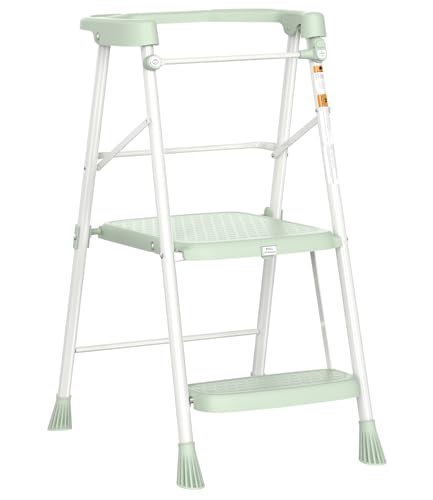
💡 Pro Tip. Listen for the locking click each time the stool is opened before your child steps onto it. Parents like how quickly this model folds and moves around, so making the lock check part of that routine keeps the convenience from becoming rushed setup.
Best Activity Tower: FlyingBoom Foldable Toddler Tower
The FlyingBoom Foldable Toddler Tower combines counter-height access with several built-in activities, including a clock, gears, chalkboard, whiteboard, and number-and-fruit matching. The solid wood design also includes a safety net and removable two-step stool, while a one-touch folding mechanism lets the larger structure collapse for storage. It works especially well for families who want the tower to offer something to do even when it is not positioned at the counter.
- Recommended for ages 18 months to 5 years
- Measures 28.1 by 23.7 by 35.4 inches with a weight capacity up to 150 pounds
- Includes 2 adjustable height levels and folds to a 6.7-inch profile

💡 Pro Tip. Use the tower with bare feet or grippy socks rather than smooth socks, and keep the standing platform dry. Some parents report that the surface can feel slippery, even though the construction generally receives positive feedback.
Best Splurge: Guidecraft Contemporary Kitchen Helper
The Guidecraft Contemporary Kitchen Helper pairs a hardwood and birch plywood structure with a folding design that becomes much more compact between uses. Four-sided coverage, two removable Keepers, an anti-slip mat, and an adjustable platform create a more enclosed standing area than a basic step stool. It also arrives mostly assembled, so initial setup is limited compared with towers that require building the full frame.
- Recommended for ages 18 months to 5 years
- Measures 23 by 23 by 36 inches with a weight capacity up to 125 pounds
- Includes 2 platform heights at 15 and 18 inches

💡 Pro Tip. Make sure the Guidecraft is fully opened and positioned on a firm, level surface before each use. Some parents mention movement in the frame, so proper setup is especially important with this folding design.
Setting Up a Toddler Learning Tower
Always supervise toddlers while they use a learning tower, especially around hot surfaces, sharp utensils, and other kitchen hazards. A learning tower works best in a kitchen or activity area where there is enough room for a toddler to step in and out without blocking the main walkway. Keep the surrounding floor clear, and give the tower a consistent spot near the counter so it feels like part of the space rather than something that needs to move around throughout the day.
For toddlers who enjoy climbing and exploring at different heights, our climbing triangles guide covers another way to bring movement into indoor play. Our play kitchens guide is a natural next stop for pretend cooking and food play away from the real kitchen counter.
For more kitchen-related essentials, our kids’ lunch bags guide covers practical options for packing snacks and meals for daycare, preschool, and family outings.
Shopping for the holidays? Our best Christmas gifts for 2 year olds guide has more gift ideas for toddlers, including larger play pieces and activities that can stay in rotation well after Christmas.
Planning a Seattle-area celebration with more room for movement? Party Baby Seattle’s soft play packages create a dedicated play space where toddlers can climb, crawl, and explore together.
Frequently Asked Questions
Yes. Learning towers bring toddlers up to counter height for activities such as food prep, baking, washing hands, and simple hands-on projects while giving them a designated standing platform.
The OMEW Toddler Standing Tower starts at age 1. The other learning towers in this guide are recommended from 18 months or 2 years.
Yes. Many learning towers include multiple platform positions that can be changed as a child grows. The number of height settings varies by model.
Yes. Folding models collapse when they are not being used, which can make them easier to store in kitchens with limited floor space.
A learning tower provides an enclosed standing area designed to bring a young child up to counter height. A basic step stool typically has open sides and is designed primarily to provide a higher step.
Start with the recommended age range, dimensions, weight capacity, and platform height. Then compare the footprint, guard design, storage format, adjustment options, and extra features to find the model that works best for the available space.
Disclaimer: All product recommendations, setup suggestions, and creative tips are provided for informational and inspirational purposes only. Party Baby Seattle is an independent publisher. We are not officially affiliated with, sponsored by, or endorsed by the specific brands or manufacturers featured in this article. Party Baby Seattle is not responsible or liable for the safety, durability, or real-world performance of any third-party products or gear mentioned. Always refer to individual manufacturer instructions, safety warnings, and official age guidelines before use.


